Biogas Consultancy Services
We offer expert consultancy services starting from planning to implementation of the projects. We provide effective guidance to securitize your investment yielding the better return.

We offer expert consultancy services starting from planning to implementation of the projects. We provide effective guidance to securitize your investment yielding the better return.

Renewable energy is produced from sources that do not deplete or can be replenished within a human's life time. The most common examples include wind, solar, geothermal, biomass. This is in contrast to non-renewable sources such as fossil fuels.
Biogas is a combustible gaseous fuel that is collected from the microbial degradation of organic matter in anaerobic conditions. Biogas is principally a mixture of methane (CH4 ) and carbon dioxide (CO2) along with other trace gases. Biogas can be collected from landfills, covered lagoons, or enclosed tanks called anaerobic digesters. The biogas typically has 60% methane and 35% carbon dioxide. There is also some percentage of hydrogen, nitrogen, oxygen, ammonia, moisture etc.
Waste / Bio-mass sources like agricultural residue, cattle dung, sugarcane press mud, municipal solid waste and sewage treatment plant waste, etc. produce bio-gas through the process of anaerobic decomposition. The bio-gas is purified to remove hydrogen sulfide (H2S), carbon dioxide (CO2), water vapor and compressed as Compressed Bio Gas (CBG), which has methane (CH4) content of more than 90%.
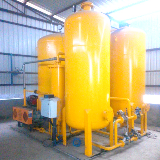
Pressure Swing Adsorption (PSA): This technology is most prevalent for large bio-gas systems in India. With this technique, carbon dioxide is separated from the biogas by adsorption on a surface under elevated pressure. The adsorbing material, usually activated carbon or zeolites, is regenerated by a sequential decrease in pressure before the column is reloaded again, hence the name of the technique. Hydrogen sulphide and water needs to be removed before the PSA-column. There is significant loss of methane (20-30%) in this process.